Tag Archives: Objectives

Digitized Contract Management

Automating the contract management process has long been part of an organization’s digital aspiration, however there seems to be a lack of clarity on what this really entails and delivers.

Go Digital caption image white on blue

Depending on who you talk to, you will get different views. The dilemma originates in the unconnected goals of the individuals utilizing the solution. Unfortunately there can be conflicting priorities that will influence the path that organizations take, and together with a lack a vision across the end-to-end contract management process, organizations miss significant service, cost, and risk improvement opportunities.

Typical Digital Journey Steps (1-2-3)

Step 1

Contract signing – use of digital signatures. This initial step will speed up the signing process and there are a number of electronic document signature platform solutions on the market. These solutions can handle both paper and electronic formats to support a transition from an existing manual to digital process which is useful when you are beginning your digital journey.

Importantly there needs to be clear policy guidance on what documents can be signed digitally. The more rule exceptions or exemptions to using digital signatures, the harder the organization will find it will be to achieve a 100% user adoption.

Step 2

Great, you have now have individuals invested in a paperless approval process however did you think about how this document signing process was fed in the first place.

Step 2 avoids the manual scan, upload, tagging and administrative pain that is created if the digital signature solution is not integrated directly with the contract management system. This means the contract management system becomes core to your digital approach.

TIP: Ensure that your digital signature and contract management solutions ‘talk to each other’ out of the box.

Again, there are numerous digital platforms out in the market – some with very rich features, however adoption success remains challenging. This is where the organizations needs to understand ‘what’ standard form drives customer and supplier contract generation.

TIP: Ensure your standard form documents cover 80%++ of your scenarios and relevantly reflect the products and services you are selling/ acquiring.

Respective end-customer and supplier contract creation and generation is essentially the same process, but complexities may differ due to different market positioning. For example, you may have to use the ‘other parties paper’ as the start point where that client or supplier organization has a greater balance of power rather than using your own standard terms & conditions. Assessing respective document volumes, complexity and $ value is key to unlocking an appropriate contract management process.

TIP: Establish a centralized ‘secure’ contract document repository with relevant templates, appropriate user support and role access

Keyboard T&C blue button

Authoring functionality may look cool, but it does not always make sense if you have standard preset terms & conditions, non-disclosure agreements, and/or other master documents. If we do need amend terms, we need to consider the negotiation process – how do we negotiate and conclude red-lines with the other party?

For many medium to large organizations, roles and responsibilities are segmented – Legal look after legal aspects, Procurement / Sales look after the commercial aspects etc. This means that contract management system needs to support the way the business operates its process flow i.e. the practice of ‘how’ the organization generates and concludes a document ready for signature?

TIP: Ensure your contract management system has the ability to be support internal and third party collaboration within the respective ecosystem partitions.

For example, do you need to establish a Purchase Order before signing the contract or the other way around? How is the contract document linked to the organization’s order management process. Is there 100% contract compliance across the organization?

Institute of Supply Management (2017) research suggests only 60%-80% of the organizations business transactions are governed by some sort of written agreement.

At the heart of contract digitalization are business policies. For example, ‘who’ within the organization is authorized to sign, ‘who’ has the final say on value versus risk, ‘what’ delegation of authority levels exist, ‘who’ has ownership of audit and compliance responsibilities etc. This must be understood to design and optimize the contract management process.

TIP: Who owns the contract, execution and management and is ‘on-point’ when the contract needs be leveraged. This is the value that must be qualified and quantified to support the determination of the ‘right’ process flow solution

Step 3

So we have dealt with the complexities and process ‘what’, ‘how’ and ‘who’ but has the organization connected the reasons for the contract ‘why’. Organizations need to consider the balance between value and risk. For example, organizations acting with zero risk appetite can make your business unattractive or closed for new partners/suppliers with onerous liabilities, insurance and or other terms. An unwieldy and lengthy contract management process benefits no one.

IACMM research suggest that 70% -75% of commercial issues lie at the heart of most troubled contracts (CPA Global 2016, “Excellence in Contract Management”)

Contract Lifecycle Management (CLM) steps beyond the contract management generation and signature process and deals with the delicate balance between:

i) Partner /Supplier performance, and

ii) Risk mitigation

Man balancing on tightrope

In the ‘digitalized’ world, we need to capture those performance attributes and risk factors in the ‘meta data’ to monitor and manage the contract. The challenge is that CLM requires cross-functional data inputs that originate from other platforms. This means that CLM is much more than a digitized agreement; it needs to be integrated more holistically to ensure that the end-to end dataset supports an operational process. The goal is to operationalize contracts to aid and drive value across the organization.

Good contract development and management can increase company profitability by 9% (World Commence & Contracting 2022, ‘ Poor contract management cost companies 9% – Bottom Line’)

To maximize impact, CLM must transition from a legal tool into an operational tool that allows organizations to optimize cost, quality and time. Establishing appropriate performance measures and smart reporting is critical to monitor and manage the value and risk balance.

“Instead of providing boxes to check to demonstrate compliance, output from frameworks should be a roadmap for improving business performance. It’s a way for companies to examine their current processes and pinpoint where they are going wrong via comparison to global best practices”

Ronald Lear, CMMI Institute Director of IP Development

TIP: Visual dashboards, such as the use of heat maps, are great at highlighting specific ‘focus opportunities’.

Ultimately contract breaches and remedy execution end up becoming legal issues, however good contract management intersects with good customer/supplier relationship management. Mitigation and prevention are preferable to cure. The true value of digitization is the power to manage a relationship actively rather relying on a passive document hiding in someone’s bottom draw.

TIP: Apply continual due diligence. Not only agree and check risk factors before you enter any agreement, but conduct regular ongoing reviews during the agreement term. A 360 view of the customer/ supplier relationship can be enhanced with specialist third party data covering where required: reputation, credit / finance , legal, security, environment, social and governance, supply chain inputs etc.

Conclusion (3-2-1 reversal)

If you know the journey potential, then arguably the contract management digitization process should not be owned by the legal function. The business needs to lead this based on a broader set of value and risk measures.
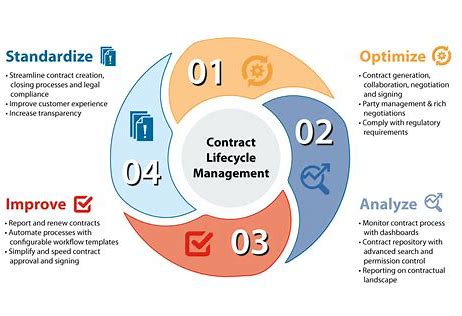
With and without digitalization, contract operationalization is extremely challenging – the organization can become ‘bogged down’ with data entry and information overload. This requires a robust vision on how to set-up an optimized process to connect individual goals.

Already have a digitized contract management roadmap. Whose goals have been prioritized? Contact Us.


Procurement’s Innovation Dilemma

>>Evolution of Lap Time<<

F1 cars have become dramatically faster over time, and estimated to be 2x as fast as the original cars.

In recent times, speed improvements have slowed given the rise of ‘competition’ game changers such as safety, fuel economy and stakeholder interests. The goal posts are always moving; the F1 purpose evolved – its values changed.

Purpose of the Past

Sounds familiar? Your organization wants to improve the performance of procurement and ‘raise the bar’, however:

  • Procurement performance is ‘hard wired’ to cost savings –  price becomes an easy measure; cost is much harder to quantify and evidence; and non-cost factors valuation is over simplified to pass or fail
  • Procurement investment targets the sourcing and bidding processes – there are clear tangible wins especially where there is a ‘low bar’
  • Innovation investment is riskier, continues to ‘raise the bar’, but often targets value beyond cost savings
  • Procurement becomes stuck to its traditional ‘hard wire’ output (it is less risky and sits within their existing comfort zone). Particularly where an organization fails to change recognition and rewards; these form passive barriers to change. The ‘bar’ becomes fixed.

A breakthrough is required to avoid the law of diminishing returns.

>>New Purpose required<<

Where you innovate, How you innovate, and What you innovate are Design Problems

– Tim Brown

Using the F1 analogy, there will be a point where organizations need to evolve their purpose; either driven by the customer, regulation or market disruption. It becomes clear when continuing to ‘raise the bar’ that the same organization will need to realign their value and performance measures. This is a common ‘ high bar’ challenge. Of course speed remains core to F1, as costs will be for Procurement >>

Implications for Procurement

  • Procurement no longer have cost savings goals as their only objective
  • New value measures need to be established to reflect an enhanced and changed purpose – this requires a different procurement mindset
  • Innovation programmes enable new purposes. This requires investment, planning,  talent and leadership. Set a ‘why you innovate’ robust vision at the start!
  • Transformation is a business journey involving extensive internal and external change management.  Transformation takes time (typically measured in quarters and years). Tackle roadblocks quickly and stay consistent to the vision.

The game just became more complex. Is your organization changing Procurement’s Purpose?

Eating your own dog food

Or my preferred “Drinking your own champagne” are terms to describe the practice of using your own products and services. It serves as testimonial evidence that practices what the company preaches, and demonstrates a high level of faith in the quality and value derived.

It seems strange therefore that organizations marketing sustainability credentials, citing net zero aspirations, but have a reputation not to “walk the talk”, expect third parties to sign sustainability pledges without question. This lack of leading by example is a quick way to destroy credibility of the program before the start.

According to Forbes, there are 6 mistakes that organizations make when building a sustainability program:

  1. Setting goals before properly assessing the impact
  2. Failing to identify the right do-ers and deciders
  3. Not effectively measuring progress towards your goals
  4. Using sustainability only for PR
  5. Failure to test strategies before applying them to scale
  6. Not asking for help

This research was conducted over 2 years ago and is still relevant today.

Need help. Contact Us.

Buying, Purchasing and Procurement – What’s the value difference?

For those working in the supply side profession, the perceived performance difference between these roles can be enormous. Is this because we are fixated by titles and getting recognized? Probably.

Titles aside, the challenge within any organization is articulating your value add. Where organizations are inclusive, and there is an understood benefit for a particular role, titles become less important. The team normalizes effort and then starts to synergize performance.

In those organizations where the functions are less mature, and or management is less experienced with best practices, there is a need to establish and build a function brand / reputation to underscore your targeted value add. There is a broad spectrum of skill set expertise / emphasis which requires us to position and differentiate roles. To confuse further, organizational roles titles may be interchanged which blurs the understanding around the role deliverable emphasis.

Key supply side function roles

Buyer: This role traditionally supports and generates the PR/PO transaction. This administrative role is important but tends to be overshadowed by the more strategic elements involved in supplier selection, negotiation, contracting and management (buying process). Check out a couple of Buyer job descriptions. Getting a super star that delivers the strategic elements as well as attending to the administration detail is rare. Individuals tend to have either strategic or transaction skill biases.

Purchasing: This role incorporates the strategic elements of the buying process, however there is more emphasis on compliance and governance activities. A common complaint about the purchasing process is that it seems to be arranged to hinder business, is risk adverse, and too focused on price rather cost. Together with a tendency to be reactive, ticking boxes rather than adding value can be an easy trap for less developed purchasing functions.

Procurement: This role includes all of the purchasing elements, and is typically targeted to add value and improve total cost of ownership. Procurement is much more strategic than Purchasing, and better aligned to organizational goals. Moving from a reactive to proactive approach is a key enabler for the function to deliver value. There is a much more emphasis on relationships. The downside is that the long game requires more effort and time investment. The upside is that business benefits are much greater (see my article x10 Impact).

The supply side source, contract, purchase and pay cycle is common throughout all the roles; but depending on how you position the function, the emphasis changes. For those within the supply side function, procurement positioning is generally preferred because of its strategic nature. This is not to suggest that the emphasis associated with the other roles is less important. Many larger organizations separate out the roles within the overall function to help manage the different elements of the value chain. Super stars are difficult to find, and harder to scale when you expand the function.

Positively, a recent survey suggests that 85% of respondents position the function as strategic. This is great news, however a more in depth survey is required to better explore the organizations understanding and valuation of their supply side function.

LinkedIn Survey screenshot

Operating Model

An operating model is the way an organization does its work, and considers the structure, roles and collection of processes it uses to perform the work. Depending on the supply side function capability and aspiration to build its brand/reputation, an appropriate operating model needs to be developed. Starting with the basic role building blocks and moving up the value stack is a journey and a valid strategy. Note: matching capabilities with the operating model is a continual balancing act. Change management is required.

For those organizations with the supply side function already positioned at the strategic procurement level, I wonder if the operating model is truly aligned with the targeted brand/reputation – Is it where you want it to be? We know there is always room for improvement and alternative ideas and strategies exist.

To conclude, titles and positioning statements are a matter of matching and marketing the function. The reality is that customers value what they value! The real test is whether you have the capability to deliver that value.

What’s your value add? Have thoughts. Please share. Contact Us.

I’m a Celebrity … Get Me Out of Here

For those Brits in the UK and aboard, we cannot help getting hooked into this reality TV classic. Throwing a whole load of celebrities into the jungle, restricting creature comforts and keeping them hungry is not only an entertaining formula, but surprisingly, a great insight into talent management and team dynamics.

On reflection, there are seemingly a set of lessons arising from life in jungle that can be learnt and applied in your organization:

1. Setting a common goal

Winning stars that are linked directly to the amount of food the camp receives creates a unifying goal that motivates all individuals in the same way.

2. Team membership

Individuals earn stars for the camp. Each individual knows how important their contribution is to maintain camp accord. They have accountability combined with a sense of duty to do their upmost for the team. As the individual wins, the team wins, and over time, the camp understands sustained success and longevity is dependent on overall team performance. Individuals identify themselves as a team member.

3. Sticking to your swimlane

Whilst bush tucker trials are allocated randomly by public vote, individuals naturally adopt and manage roles and tasks inside the camp that they perform well and are comfortable with. Leveraging members strengths and staying within a swimlane, actually maintains stability within the camp and earns recognition from other team members. Discord arises from individuals moving into other member swimlanes, or being tasked to move outside their own comfort zone. Similarly in business, where individuals fail to respect functions and process, and step on toes that others consider their responsibility; this invariably leads to friction.

Lessons

For those advocates for off-site or on-site team bonding courses – I would agree these are fun, but often when the team gets back to the day job, the core alignment elements are missing.

Team dynamics are delicate and good leaders understand the need to allocate and delegate in an inclusive way. Understanding swimlanes, defining common goals and building teams that perform together is a winning recipe.

Motivating and moving forward in business is of course more complex; and maintaining accord is challenging. As in the camp, regular discussion, feedback and praise is needed to ensure that team members feel valued. Conversely, offering creature comforts that are not valued or creating barriers to isolate team members is proven to be a poor strategy.

Keep your team talent and avoid the alternative “Get Me Out of Here” discussion!!

Have an insight?

Rumble in the Jungle. Contact Us.