Tag Archives: Execution

New Mindset – 2025 Adventure

After a period of recent introspection where actual AI procurement project progress versus hype expectation continues to be a challenge, there has been a forced rethink of the mindset required to maintain a steady course.

Many of us, myself included, prefer a structured approach akin to ‘a journey’. We are driven by a vision, an end-destination, with a plan including appropriate stop off points to recheck and validate whether we are on-track, with periodic course corrections to ensure that we feed-in new data, as applicable, to adjust the approach.

In today’s environment, it seems that organizations are failing to maintain a steady course. Fueled by a high level of business uncertainty, the experience is extremely unsettling and demotivating.

Progress can be a positive experience if managed well, however the disconnect is exacerbated if there is a lack of credible use case, questionable and inconsistent leadership and inability to translate the vision into execution. Accordingly to Rand research (The Root Causes of failure for Artificial Intelligence Projects and how they can succeed, Aug 2024) 80% of AI investments are destined to fail; twice the rate of failure of IT projects that do not involve AI.

Having attended a recent AI in procurement ‘thought leadership’ session, it leads me to conclude our industry pundits have little actual evidenced tangible outcomes. Typical statements such as the below send a mixed message:

  • We think …. improved automation
  • We believe …. new solutions we cannot imagine
  • We estimate …… improved data analytics
  • We forecast ….. a change ?!

My main concern is that there are few actual use cases that have been successful. Either most remain as work in progress or if successfully completed, business’s are keeping them under wraps. The conclusion, whether we go ‘left’ or go ‘right’, is to adopt a different mindset and instead consider the journey as an adventure. Just do not believe it’s a done deal!

Disagree. Collaborate and share your AI use case success. Otherwise enjoy the ride and have fun!

Oh no, now we have Intelligent Automation (IA)

To add to the already long list of existing and confusing digital technology acronyms; we have Intelligent Automation (IA). IA uses AI but builds on automation technologies such as Robot Process Automation (RPA). The diagram below illustrates the intersection perfectly.

Our previous articles have highlighted that AI is not yet widely adopted by many organizations and remains largely at the proof of concept stage.

A recent report from Hackett Group [2024 Procurement Agenda and Key Issues Study] underscores the progress of digital automation adoption and better illustrates the relative adoption success between RPA and AI. According to Hackett, RPA is adopted, or in the process of adoption, by 51% Procurement functions studied compared to 28% for AI.

RPA is not AI

RPA uses rule based scripting to integrate and perform repetitive tasks. It follows a process defined by the end user, however RPA can utilize AI agents. These AI agents can recognize patterns in data, in particular unstructured data, learning over time.

Value Proposition Expectation

The Hackett study differentiates between solution suites, such as ERP, and point technology solutions. Gen AI, RPA and ChatBots are all point solutions. The low level of large scale deployments of Gen AI (5%), RPA (19%) and Chatbots (6%) suggests a need to join up the ‘points’ and develop more suite solutions for procurement organizations to leverage.

Looking into the crystal ball and beyond the current AI hype, the combination of technologies would suggest that IA, which incorporates sub-disciplines of AI, like ML and Natural Language processing (NPL), is the logical and practical ‘suite solution’ outcome which we predict to be the digital automation toolset that provides real executable value for procurement.

IA could be that sweet spot that realizes the true potential of AI to deliver business value.

IA or AI : What is your success prediction?

Technology fatigue? Changing Procurement’s Perspective

As we collectively look forward to our summer time break, the opportunity to recharge the batteries and step back is a welcome rest. User fatigue is common challenge in technology evolution; user dissatisfaction, lack of trust in technology, frustration and lost interest reduces the level of user engagement and motivation in technology adoption.

Within Procurement, there are myriad of AI use cases that offer potential but currently lack tangible and demonstrable output.

Risk Aversion

AI is hampered by bad data but the lack of trust in the technology blinds decision makers in endorsing ‘finding a better way’. This vicious cycle creates a detrimental effect, or even the perception of high risk.

Organizations that are risk averse have a higher level of user fatigue (The Institute Risk Management Risk Appetite & Tolerance Guidance Paper, Sept 2011) . The balance between ‘reward’ and ‘risk’ must be explored and purposefully agreed by the business.

Gartner Research Feb 2024, ‘Embed Total Cost of Ownership (TCO) in Procurement Teams to Optimize Value’, recommends TCO principles to improve business performance success. This perspective requires a new set of value measures, triangulating additional datasets housed across various internal and external systems. Procurement organizations must prioritize data integrity to minimize user fatigue. Note: You can have the best AI technology, but if there is no trust or use case benefit, adoption and ROI remains zero.

Data integrity considers not only the accuracy and consistency, but the ways data is interconnected across disparate systems to create ‘single sources of truth’ with high quality data.

Addressing the risk that AI itself impacts the organization’s data quality is another concern. According to McKinsey, “some 71 percent of senior IT leaders believe generative AI technology is introducing new security risk to their data.”

90% see improving compliance and risk as important for driving their data-driven decision intelligence investments ​​​
Source: ProcureTech research

Increasing Complexity Trend

Accordingly to Gartner, increasing supply chain cost and complexity, as well as economic and geopolitical instability, are significantly impacting business margins and supply continuity. Inevitability this means that organizations will require more TCO data points to manage the evolving supply chain scope.

Structuring unstructured data will make it a business asset.

Back to Basics

Seemingly the procurement road to success is not only to change the perspective, but to take advantage of technology, they must revisit their risk and reward balance. Understanding how to deliver improved data integrity within the supply chain will support the journey of winning ‘hearts and minds’.

AI is intended to simulate human intelligence and the ability to acquire and apply knowledge in an application that users trust and adopt will be a critical success factor.

Execution is Everything. AI is coming home. Share your Perspective.

Another Year to reflect

As the US financial markets end on a high, it is interesting to see the influence of AI technology stocks with the likes of Google, Nvidia, Meta and Tesla central in a booming confidence for all things AI.

There are high expectations that AI will transform our world, and personally I am intrigued with Optimus, Tesla, humanoid robot. This first appeared back in 2022 and has since gone quiet. The idea was to have the AI robot operate in car manufacturing plants , essentially doing tasks that are repetitive but need skills that can deal with, for example, installing flexible hoses that bend and twist which require an ability to adjust and manipulate grip similar to a human hand. This I, Robot, theme is just one prospect that delivers a human aid outcome, however it seemingly looks like that AI is more destined to become a data analyst.

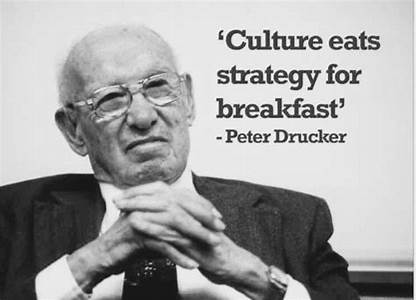
AI algorithms are data hungry and will need ever more access to data to compute outcomes, well beyond the human mind capacity to actually digest. Whilst self aware AI will be able to make their own decisions, organizations (and the people running them) are unlikely to allow the machines to achieve full ubiquity as Peter Drucker famously said;

This means that no matter how great your product, technology or strategy, its success will be held back if there is no willingness or cultural alignment. It’s the people executing the strategy that brings it to life.

Shared values unite culture to strategy. If your company’s unique selling point is innovation, a culture based on price efficiency would not work. Our vision, values and mission – culture – determines whether a strategy will succeed or fail.

Whether it will be AI identifying a face in a crowd for potential security threats, or predicting how a stock will perform, the output will required a trained human to ratify the recommendation outcome. We have created another format where consultative ‘cognitive’ solutions will developed to ensure that the market continues to ‘pay for advice’.

In the case of driverless cars, the progress in AI has been outstanding, however most governments will not allow a fully autonomous solution without a human seated behind the steering wheel. Safety concerns have not yet been fully overcome.

From a procurement perspective, the real impact of AI is far from clear. There are numerous approaches and options to execute vision. AI ‘s impact on the procurement transaction, rather then being self-determined, is more likely to result in the procurement professional overseeing and managing the output to ensure alignment. Feeding into AI programming and system design requires a strong procurement, supply chain and business partnership understanding.

It will be interesting to see how AI develops in 2024. Happy New Year.

Cook, Eat and Repeat

This week’s inspiration is taken from Nigella Lawson’s BBC ‘cook, eat and repeat’ recipes, and having now survived the doldrums of the first month, attention is now truly focused on the opportunities ahead.

With the new year comes new resolutions, new budget and a sense of positive energy, digital tech firms are searching for better ways to inspire procurement professionals can leverage technology and avoid failure. One way to remove the fear is to ensure that someone else has tried it before, and discovered what works and what does not.

Unfortunately what makes sense and tastes terrific differs per individual. This distortion means that there is a reluctance to document the recipe. Why? Cook books have a range of recipes, not all may appeal, but they are here to help. Try one, if that does not succeed, try another, Once you have discovered a recipe that works, share the recipe with others. Success is repetitive.

Where to Start

Where do you find that elusive cook book? Find an experienced cook who has developed their own independent cook book, or at least able to access a library; that is well-versed across range of recipes, and capable of assessing what is likely to be attuned to the organization’s taste. Find and establish the recipe that works – it needs a mix and balance to perfect the outcome.

In simple terms, technology implementations follow the same ‘cook, eat and repeat‘ philosophy. Importantly……

Follow the instructions

  1. Use the prescribed ingredients (apple pie without the apple is not apple pie)
  2. Utilize the best ingredients you can afford (leadership, talent, team)
  3. Understand the cooking time (if someone wants a well-done steak but cooks it for 30 seconds, it will not be well-done)
  4. Assess success by arranging tasting sessions (“feedback is the breakfast for champions”)
  5. Sell the fact that you have found a tasty recipe. Others will be keen to have a try!

You might find this cooking analogy too simplistic, however given the successful introduction and adoption of digital technology remains a major challenge, what will you do to explain the process?

Ready, Steady, Cook! The best time to find your success recipe is to start now. Contact Us.

New Year Resolution

This is the Chinese year of the rabbit. There are number of business technology trends being predicted to help kick off 2023. Thank you to those that are sharing – there are so many exciting potentials for these solutions to add value, however I am reminded of the race between the rabbit and tortoise.

This cautionary tale reminds us that ‘slow and steady’ wins the race. There is a temptation for organizations to prioritize time, solution deployment, ahead of all other factors. The pressure to deliver ‘something ‘, ‘anything’ to meet management expectations is not only counter productive; it can result in teams burning energy needlessly. The drop out with team members chasing dead ends, loses momentum and motivation, and results in team churn and failed deliverables. This is equivalent to the rabbit tiring and needing to take a nap!

Steadiness and consistency will let you win like the tortoise did.

What’s your new year resolution?

Costing (‘the avoidance of’) Digital Failure

How do we qualify the cost of failure and reflect this in the business case to underscore the need to invest adequately? There is well documented research on the low success rate of digitalization initiatives, poor adoption and delayed deployments, but little on the actual $’s involved.

In order to better understand the cost dynamics, imagine an iceberg. The visible tip is the smallest part of the iceberg. This is analogous to the cost of software. The largest part is below the water line, often hidden, and is analogous to the cost of the professional services to implement and execute a digital platform. It is not uncommon for the software: professional services cost profile mix to be around 1:9.

iceberg above and below sea

Software 10%

Professional Services 90%

To clarify, digital platforms require end-to-end integration – they are not standalone apps. Given this cost imbalance, getting to grips with the professional services element is critical.

Professional Services costs are determined by skill set rate card multiplied by days effort. For large and complex projects, forecasting skills and effort can be challenging. Taking a leaf from the manufacturing industry, lean and six-sigma practices, I am reminded that:

“Cost is more important than quality, but quality is the best way to reduce cost”

Genichi Taguchi

How do we increase the probability of success? My article ‘Improving Your Digital Transformation Success Rate‘ outlines key factors that an organization needs to address to improve success rates. The downside is the investment required as business cases can be challenging at the best of times.

How do we get value for money? Organizations need assurance that costs will be fixed and controlled. There is a temptation to cut corners and if the true cost of the professional services element is hidden; the business case becomes software centric and likely to become another failure statistic. A better way is to qualify the costs of failure when assessing the scope and level of professional services. What if we need to rework, increase the volume of change requests, write-off work, delay the project, perform more tests, suffer from low adoption etc. ? How would that impact the business case? This cost avoidance argument can be used to balance and justify a broader understanding of a more comprehensive business case.

How do we mitigate and reduce the cost of failure? Allocate the best talent to the initiative, and perform in depth due diligence on any external professional services provider to ensure you get the best quality professional services. Low price, administrative, unskilled resources will have a negative exponential impact and increase the cost of failure (adding to the below the water line iceberg).

Organizations that fail fast, learn fast have inherent capability to adapt and course correct as they ride the wave and are typically those already operating best in class with a high level of maturity. For the remaining majority, digitalization can be complex and daunting. We learn from our mistakes, but sometimes we need it ‘right first time‘. Otherwise, failure becomes extremely expensive.

Need Help. Contact Us.

Crawl before your Walk, Walk before you Run, it’s a Digital Journey

Digitalization projects are difficult. It’s not about the technology. Yes technology plays a part but it is understanding how the potential technology can be applied and developed to shape the user experience, aka customer journey.

There is a temptation to jump in without any directional oversight which frames the anticipated customer journey. These plans, or roadmaps, are more than a project timetable; they consider how the user interacts with the technology as well as the required functionality. This forms the minimum viable product (MVP) – both aspects must be addressed. A common failing is to get lost in the technology, and ignore the user.

A better way? Perhaps?

A personal frustration is the lack of data points assessment. Cutting through and making sense of the various data points is key in producing a storyboard that delivers both efficiency and effectiveness. Who get’s data, what do they do with it, how is the decision reached, what is the data output are some of the questions that need to be asked and addressed. Understanding the customer journey involves a more holistic appreciation of the end to end process.

Similarly when the business fails to assess data quality, data remains ‘dirty’ and unstructured. It seems crazy that organizations believe that they can ignore these factors and succeed. For example, imagine a zero-touch accounts payable invoice goal where the supplier master data is just garbage and missing bank accounts.

Embedding this into the roadmap ensures alignment on a facts and data basis. Where there is mismatch on MVP, change the phasing or delay the project.

Quick win?

In some cases preparing solid foundations for digitization can take years. A good example was the ebook value chain: obtaining rights from authors and agents and setting up the electronic distribution business model were critical to enable the introduction of the ebook. This was not a quick win.

There is no clean start or stop: goal posts move, organizations grow and evolve, new functionality becomes available, customer demands alter – there is constant change. This is the digitalization journey.

There may be options for quick wins; depending on the context. In the main these will be determined by the quality of the digital foundations and how quickly they can be re-validated. These broader factors can become barriers if you fail to address.

Technology is an enabler. Central to the digital journey is the customer experience. These factors influence your critical path. Line up the planning sequences and eat that elephant in the room, one bite at a time!

Are you still crawling? Contact Us.


Improving your Digital Transformation success rate

According to BCG, the success rate for Digital Transformation is less than 30%, however they identified 6 key success factors that can reverse the odds to 80% (BCG, 2020, Flipping the Odds of Digital Transformation Success). The study indicated crucially that all the 6 key success factors had to be addressed. Where only some of the factors were addressed in part or full; partial effort still led to failure.

Digital Transformation image

The success factors they identified were:

  1. Presence of an integrated strategy with clear Digital Transformation goals
    • A clear plan on the why, what and how supported with quantified and measurable benefits
  2. Commitment from senior leadership team.
    • Clear top down sponsorship
    • High engagement and alignment
  3. Use of High Quality talent
    • Allocation of the most capable team resources to support the program
  4. Having an ‘agile’ mindset to govern the program and to accelerate adoption
    • Tackle roadblocks quickly, adapt to the changing contexts, and don’t delay in the pursuit of perfection
    • Awareness of shortcomings and creation of an action plan as you progress
    • Mastery of continual innovation and improvement
  5. Effective progress monitoring
    • Establishment of clear success metrics with sufficient data availability and quality
    • Maintaining eyes on the broader goals
  6. Business led [this is not an IT led project]
    • Business needs driven
    • Integrated modular technology platform that can seamlessly scale across the ecosystems.

More concerning is that a more recent Gartner survey indicated that only 22% of procurement leaders have a long-term Digital Strategy (Gartner, 2022, Procurement Digital Strategy). The reasons for this were not captured but the implication for those procurement leaders and laggards unable to develop a strategy and convince the leadership to invest does not bode well.

Of all the success factor combinations, only where all 6 are present, will an organization sustain digital transformation success. The conclusion is that adequate preparation, planning and execution time and $ investment is required. No revolutionary insight, yet not easy!

Need help to form a strategy and increase your success rate. Contact Us.


Procurement Leadership Competencies

In this age of supply chain disruption and market shocks, what are the key attributes Procurement need to navigate these challenging times to sustain value:

  1. Understand the business and supply market
    • Without the fundamentals of understanding your business needs, Procurement cannot align its supply side strategy to support business success
    • Finding and matching the right strategy to those business goals requires procurement leaders to act and think like business managers
  2. Transformational leadership
    • Transformation and change management requires procurement leadership to have a clear vision with benefits that can be articulated appropriately across the different stakeholder groups. Communication skills are critical.
    • Walk the talk, leading by example, helps build trust with stakeholders
  3. Know the Technology
    • Technology is only an enabler – it is only one element of the success equation
    • Map and apply the right Technology based on the maturity of the function and organization
  4. Transition the Operating Model
    • Change the model – insanity is doing the same thing again and again, yet expecting different results #
    • Take small bite steps that support incremental improvements in a steady direction
    • “Sell success based on success”
  5. Collaborate with Partners to Innovate
    • External supply side resources are typically the largest single resource pool available to the organization – involve your partners in your business challenges
    • Share benefits to encourage win/win
  6. Operate flexibly and transparently
    • Open your mind to alternative approaches
    • Challenge and change to seek better ways

Food for thought. Need help. Contact Us.