Category Archives: Talent

Power Team Squared

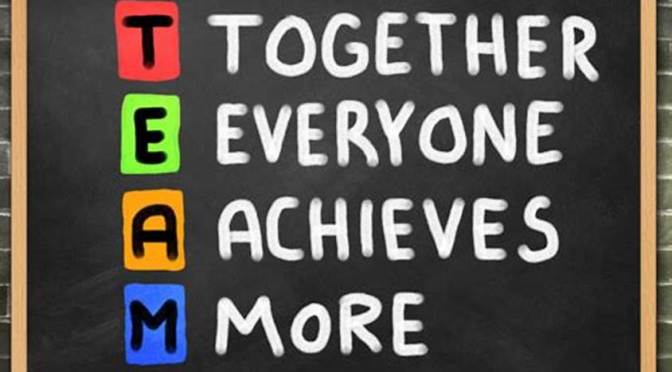
Last week I met up with a couple of my ex-colleagues and was reminded how the power of team was truly awesome.

“Great things in business are never done by one person; they’re done by a team of people”

Steve Jobs

The ability to create and form high performing teams is an indication of great leadership, and whilst we all recognize individual performance and contribution, prioritizing individual performance limits success as a whole.

The opportunity to become a valued team player is personally fulfilling, however organizations have difficulty in quantifying business synergy (the total is more than sum of the parts) success. Giving this measure challenge, individuals tend to be geared towards independent goals. A common organizational pitfall is the way individuals are allocated objectives. Team or project initiatives are set the same functional ‘silo’ business as usual measures – none reflecting the value add of the ‘improvement’ that will materialize across the business as a whole. For example, imagine if a procurement goal was to reduce the volume of accounts payable invoicing issues.

Good leaders understand the need to think holistically, break down the barriers and use the bigger picture to inspire and motivate. Individuals can become frustrated if there is a lack of vision and strategic direction with respect to an overall business outcome – we all need to glimpse the ‘light at the end of the tunnel’ and have our role explained as part of that success journey.

Technology enablement requires cross functional collaboration and it goes without saying that one of the most important ‘success’ ingredients is to align the best talent and have them operate as ‘one team‘. Internal communication and dysfunction remain the biggest hurdle in organizational transformation, and leaders must ‘commit’ to ensure that these initiatives are resourced appropriately, supported wholly, and visibly recognized as being critical to the overall vision.

This is more than sending individuals on team building development courses. To address the challenge in bringing back those lessons into the workplace, great leaders set the agenda to frame team success.

What’s your next BHAG (Big Hairy Audacious Goal)?

Cook, Eat and Repeat

This week’s inspiration is taken from Nigella Lawson’s BBC ‘cook, eat and repeat’ recipes, and having now survived the doldrums of the first month, attention is now truly focused on the opportunities ahead.

With the new year comes new resolutions, new budget and a sense of positive energy, digital tech firms are searching for better ways to inspire procurement professionals can leverage technology and avoid failure. One way to remove the fear is to ensure that someone else has tried it before, and discovered what works and what does not.

Unfortunately what makes sense and tastes terrific differs per individual. This distortion means that there is a reluctance to document the recipe. Why? Cook books have a range of recipes, not all may appeal, but they are here to help. Try one, if that does not succeed, try another, Once you have discovered a recipe that works, share the recipe with others. Success is repetitive.

Where to Start

Where do you find that elusive cook book? Find an experienced cook who has developed their own independent cook book, or at least able to access a library; that is well-versed across range of recipes, and capable of assessing what is likely to be attuned to the organization’s taste. Find and establish the recipe that works – it needs a mix and balance to perfect the outcome.

In simple terms, technology implementations follow the same ‘cook, eat and repeat‘ philosophy. Importantly……

Follow the instructions

  1. Use the prescribed ingredients (apple pie without the apple is not apple pie)
  2. Utilize the best ingredients you can afford (leadership, talent, team)
  3. Understand the cooking time (if someone wants a well-done steak but cooks it for 30 seconds, it will not be well-done)
  4. Assess success by arranging tasting sessions (“feedback is the breakfast for champions”)
  5. Sell the fact that you have found a tasty recipe. Others will be keen to have a try!

You might find this cooking analogy too simplistic, however given the successful introduction and adoption of digital technology remains a major challenge, what will you do to explain the process?

Ready, Steady, Cook! The best time to find your success recipe is to start now. Contact Us.

The Age of AI: What’s Procurement’s fate?

We are now living through the fourth industrial revolution, and our daily life is being influenced and augmented as IoT, cloud, cognitive and artificial intelligence tech becomes more prevalent. The trend towards increased automation is benefiting business and improving procurement’s ability to transact.

But will it really revolutionize the way we work?

Machines are efficient at performing repetitive work, however where there are dysfunctional, chaotic, and unchartered environments; and where rules of engagement have not been established, replacing humans with machines would be considered untenable (and for future tech, seemingly improbable). For many of us, the last few years have been unprecedented, unpredictable and extraordinary. In the world of procurement, whilst many the problems have similar themes, each day brings different challenges. Although we would love to structure the business in such a way that would make it more predictable, the reality is that a large number of transactions do not follow a ‘happy path’.

the People Factor ……

Procurement act as natural trouble shooters, ‘go to’ individuals, champions of external relationships (who does the supplier call when they have an issue!), and supply chain disruptors. BUT the desired goal is not to develop a bunch of hero’s. Hero mentality reflects a process truly out of control and extraordinary effort is required to put things back on track.

Creativity, innovation and relationships are positive human factors. Unfortunately conflicted motivations, self-inflicted disarray, and obstructive organizational politics are human downsides. Typical organizations have elements of both good and bad, which means intermediaries, such as the procurement function, will continue to be in demand.

Strategy vs Transaction

Given the challenging complexity of procurement process, today’s AI investment market is targeting the simpler transaction problems: aiding and accelerating the PR/PO transaction, processing invoices that already match, asking if we want fries with our cheeseburger selection etc. This is a great start, but we want more!

AI, as a tool, has potential to add the greatest value with Spend Analytic Insights (e.g. spend trends and patterns, price variances, focus points), Contract Lifecycle Management (e.g. contract formation, key term assessment, meta data analysis, and renewal support), Demand Management (e.g. resource forecast, material shortages, order and inventory reorder), and Risk Management (e.g. spend irregularity identification, price outliers, suspect supply situations, block /value chain) Solutions.

Work impact … Advanced Procurement Business Management

Assuming we have laid the right foundations, our fate is to advance our value proposition. This is a hugely positive outcome. I am not suggesting that Procurement are more important than other functions; we are all part of the same team, however imagine a football team without a goal keeper and midfield players. Procurement can help secure and play the ball forward to ensure a team win.

Good procurement functions wear three hats: gatekeeper, subject matter expert and business partner. AI will give Procurement the ability to grasp new insights, manage by exception and develop deep expertise. Of course, the tech still needs to catch up with the hype. It will 🙂

Super powers to kick ass. Hero’s are not required!

Buying, Purchasing and Procurement – What’s the value difference?

For those working in the supply side profession, the perceived performance difference between these roles can be enormous. Is this because we are fixated by titles and getting recognized? Probably.

Titles aside, the challenge within any organization is articulating your value add. Where organizations are inclusive, and there is an understood benefit for a particular role, titles become less important. The team normalizes effort and then starts to synergize performance.

In those organizations where the functions are less mature, and or management is less experienced with best practices, there is a need to establish and build a function brand / reputation to underscore your targeted value add. There is a broad spectrum of skill set expertise / emphasis which requires us to position and differentiate roles. To confuse further, organizational roles titles may be interchanged which blurs the understanding around the role deliverable emphasis.

Key supply side function roles

Buyer: This role traditionally supports and generates the PR/PO transaction. This administrative role is important but tends to be overshadowed by the more strategic elements involved in supplier selection, negotiation, contracting and management (buying process). Check out a couple of Buyer job descriptions. Getting a super star that delivers the strategic elements as well as attending to the administration detail is rare. Individuals tend to have either strategic or transaction skill biases.

Purchasing: This role incorporates the strategic elements of the buying process, however there is more emphasis on compliance and governance activities. A common complaint about the purchasing process is that it seems to be arranged to hinder business, is risk adverse, and too focused on price rather cost. Together with a tendency to be reactive, ticking boxes rather than adding value can be an easy trap for less developed purchasing functions.

Procurement: This role includes all of the purchasing elements, and is typically targeted to add value and improve total cost of ownership. Procurement is much more strategic than Purchasing, and better aligned to organizational goals. Moving from a reactive to proactive approach is a key enabler for the function to deliver value. There is a much more emphasis on relationships. The downside is that the long game requires more effort and time investment. The upside is that business benefits are much greater (see my article x10 Impact).

The supply side source, contract, purchase and pay cycle is common throughout all the roles; but depending on how you position the function, the emphasis changes. For those within the supply side function, procurement positioning is generally preferred because of its strategic nature. This is not to suggest that the emphasis associated with the other roles is less important. Many larger organizations separate out the roles within the overall function to help manage the different elements of the value chain. Super stars are difficult to find, and harder to scale when you expand the function.

Positively, a recent survey suggests that 85% of respondents position the function as strategic. This is great news, however a more in depth survey is required to better explore the organizations understanding and valuation of their supply side function.

LinkedIn Survey screenshot

Operating Model

An operating model is the way an organization does its work, and considers the structure, roles and collection of processes it uses to perform the work. Depending on the supply side function capability and aspiration to build its brand/reputation, an appropriate operating model needs to be developed. Starting with the basic role building blocks and moving up the value stack is a journey and a valid strategy. Note: matching capabilities with the operating model is a continual balancing act. Change management is required.

For those organizations with the supply side function already positioned at the strategic procurement level, I wonder if the operating model is truly aligned with the targeted brand/reputation – Is it where you want it to be? We know there is always room for improvement and alternative ideas and strategies exist.

To conclude, titles and positioning statements are a matter of matching and marketing the function. The reality is that customers value what they value! The real test is whether you have the capability to deliver that value.

What’s your value add? Have thoughts. Please share. Contact Us.

I’m a Celebrity … Get Me Out of Here

For those Brits in the UK and aboard, we cannot help getting hooked into this reality TV classic. Throwing a whole load of celebrities into the jungle, restricting creature comforts and keeping them hungry is not only an entertaining formula, but surprisingly, a great insight into talent management and team dynamics.

On reflection, there are seemingly a set of lessons arising from life in jungle that can be learnt and applied in your organization:

1. Setting a common goal

Winning stars that are linked directly to the amount of food the camp receives creates a unifying goal that motivates all individuals in the same way.

2. Team membership

Individuals earn stars for the camp. Each individual knows how important their contribution is to maintain camp accord. They have accountability combined with a sense of duty to do their upmost for the team. As the individual wins, the team wins, and over time, the camp understands sustained success and longevity is dependent on overall team performance. Individuals identify themselves as a team member.

3. Sticking to your swimlane

Whilst bush tucker trials are allocated randomly by public vote, individuals naturally adopt and manage roles and tasks inside the camp that they perform well and are comfortable with. Leveraging members strengths and staying within a swimlane, actually maintains stability within the camp and earns recognition from other team members. Discord arises from individuals moving into other member swimlanes, or being tasked to move outside their own comfort zone. Similarly in business, where individuals fail to respect functions and process, and step on toes that others consider their responsibility; this invariably leads to friction.

Lessons

For those advocates for off-site or on-site team bonding courses – I would agree these are fun, but often when the team gets back to the day job, the core alignment elements are missing.

Team dynamics are delicate and good leaders understand the need to allocate and delegate in an inclusive way. Understanding swimlanes, defining common goals and building teams that perform together is a winning recipe.

Motivating and moving forward in business is of course more complex; and maintaining accord is challenging. As in the camp, regular discussion, feedback and praise is needed to ensure that team members feel valued. Conversely, offering creature comforts that are not valued or creating barriers to isolate team members is proven to be a poor strategy.

Keep your team talent and avoid the alternative “Get Me Out of Here” discussion!!

Have an insight?

Rumble in the Jungle. Contact Us.

Costing (‘the avoidance of’) Digital Failure

How do we qualify the cost of failure and reflect this in the business case to underscore the need to invest adequately? There is well documented research on the low success rate of digitalization initiatives, poor adoption and delayed deployments, but little on the actual $’s involved.

In order to better understand the cost dynamics, imagine an iceberg. The visible tip is the smallest part of the iceberg. This is analogous to the cost of software. The largest part is below the water line, often hidden, and is analogous to the cost of the professional services to implement and execute a digital platform. It is not uncommon for the software: professional services cost profile mix to be around 1:9.

iceberg above and below sea

Software 10%

Professional Services 90%

To clarify, digital platforms require end-to-end integration – they are not standalone apps. Given this cost imbalance, getting to grips with the professional services element is critical.

Professional Services costs are determined by skill set rate card multiplied by days effort. For large and complex projects, forecasting skills and effort can be challenging. Taking a leaf from the manufacturing industry, lean and six-sigma practices, I am reminded that:

“Cost is more important than quality, but quality is the best way to reduce cost”

Genichi Taguchi

How do we increase the probability of success? My article ‘Improving Your Digital Transformation Success Rate‘ outlines key factors that an organization needs to address to improve success rates. The downside is the investment required as business cases can be challenging at the best of times.

How do we get value for money? Organizations need assurance that costs will be fixed and controlled. There is a temptation to cut corners and if the true cost of the professional services element is hidden; the business case becomes software centric and likely to become another failure statistic. A better way is to qualify the costs of failure when assessing the scope and level of professional services. What if we need to rework, increase the volume of change requests, write-off work, delay the project, perform more tests, suffer from low adoption etc. ? How would that impact the business case? This cost avoidance argument can be used to balance and justify a broader understanding of a more comprehensive business case.

How do we mitigate and reduce the cost of failure? Allocate the best talent to the initiative, and perform in depth due diligence on any external professional services provider to ensure you get the best quality professional services. Low price, administrative, unskilled resources will have a negative exponential impact and increase the cost of failure (adding to the below the water line iceberg).

Organizations that fail fast, learn fast have inherent capability to adapt and course correct as they ride the wave and are typically those already operating best in class with a high level of maturity. For the remaining majority, digitalization can be complex and daunting. We learn from our mistakes, but sometimes we need it ‘right first time‘. Otherwise, failure becomes extremely expensive.

Need Help. Contact Us.

10x Impact

I was asked the other day to articulate the secret recipe to become a successful procurement individual. A great question!

My on-the-spot response was that procurement offered a service and by placing the customer (our stakeholders) at the center, engaging to understand needs, and collaborating with the customer to develop solutions, procurement would deliver value add that the customer actually values.

Together with this positional change, and to ensure procurement understands the business, procurement needs to act as a ‘business manager’ to appreciate the cost, quality and time factor interlock. Too often functions operate in silos and lack appreciation of what happens upstream and downstream.

A win in one function which leads to a failure in another part of the organization is not a success for the business. The challenge is finding a way forward that respects each contribution and gives individuals the opportunity to play their part within the time constraints. Moving from a reactive to proactive way of working pulls effort forward and essentially delivers more time for collaboration, but needs a level of business maturity.

Unfortunately many organizational success measures are not consistent; they can conflict and sometimes force a short sighted and short term approach within the respective function. Establishing common goals will enable individuals to work together as a team, and focus on a shared objective. The sum of the whole is greater than the parts!

My favored recipe:

  • Customer centric mindset
  • Business acumen and value creation skills
  • Team work
  • Focus

Successful procurement individuals that enact and advocate these attributes will deliver 10x impact compared to their counter parts.

Have a better and or improved recipe ? Alternatives welcome. Please share and comment.