As the US financial markets end on a high, it is interesting to see the influence of AI technology stocks with the likes of Google, Nvidia, Meta and Tesla central in a booming confidence for all things AI.
There are high expectations that AI will transform our world, and personally I am intrigued with Optimus, Tesla, humanoid robot. This first appeared back in 2022 and has since gone quiet. The idea was to have the AI robot operate in car manufacturing plants , essentially doing tasks that are repetitive but need skills that can deal with, for example, installing flexible hoses that bend and twist which require an ability to adjust and manipulate grip similar to a human hand. This I, Robot, theme is just one prospect that delivers a human aid outcome, however it seemingly looks like that AI is more destined to become a data analyst.
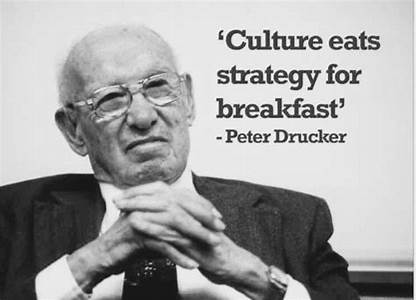
AI algorithms are data hungry and will need ever more access to data to compute outcomes, well beyond the human mind capacity to actually digest. Whilst self aware AI will be able to make their own decisions, organizations (and the people running them) are unlikely to allow the machines to achieve full ubiquity as Peter Drucker famously said;
‘
This means that no matter how great your product, technology or strategy, its success will be held back if there is no willingness or cultural alignment. It’s the people executing the strategy that brings it to life.
“You can have the best plan in the world, and if the culture isn’t going to let it happen, it’s going to die on the vine.”
Mark Fields, Ford America 2006
Shared values unite culture to strategy. If your company’s unique selling point is innovation, a culture based on price efficiency would not work. Our vision, values and mission – culture – determines whether a strategy will succeed or fail.
Whether it will be AI identifying a face in a crowd for potential security threats, or predicting how a stock will perform, the output will required a trained human to ratify the recommendation outcome. We have created another format where consultative ‘cognitive’ solutions will developed to ensure that the market continues to ‘pay for advice’.
In the case of driverless cars, the progress in AI has been outstanding, however most governments will not allow a fully autonomous solution without a human seated behind the steering wheel. Safety concerns have not yet been fully overcome.
From a procurement perspective, the real impact of AI is far from clear. There are numerous approaches and options to execute vision. AI ‘s impact on the procurement transaction, rather then being self-determined, is more likely to result in the procurement professional overseeing and managing the output to ensure alignment. Feeding into AI programming and system design requires a strong procurement, supply chain and business partnership understanding.
It will be interesting to see how AI develops in 2024. Happy New Year.
The call to innovate has never been stronger given the current market challenges. The dilemma faced by many organizations is that reality is never simple and often there is a significant mindset block in tackling how innovation requires a change in Operating Model.
The fear of failure, loss of influence or power, lack of control and inability to trust in a guaranteed outcome block changes. How do organizations navigate this?
To truly leverage innovation, you need a plan:
“If you fail to plan, you are planning to fail
Benjamin Franklin
Information + No Insight = No Strategy
No strategy? Leaders need to step up to the call to action and develop a plan to utilize innovation. This plan must address people, process and technology. Hoping technology adoption will happen just through training is over simplistic – what does it mean for the user experience? The innovation needs to deliver a well thought out advantage and resolve the WIIFME (What’s In It For Me) ‘balancing act’ across the end-to-end process. Innovation for innovation sake is not a plan. The strategy needs to be clear, insightful and deliver value.
Investment, leadership sponsorship, ‘A’ team formation are of course the usual prerequisites.
Still keen to to innovate? Establish a super user audience to ensure your strategy is smart. Even the best innovation can result in a ‘hot mess’ which will be considered as a ‘great idea, just badly executed’ if there is no clear understanding of the outcome benefits and process to capture value.
Are you a Procurement person in the business, or a business person in Procurement?
For a few organizations, procurement is considered a ‘blocker’ preventing growth and success, and regarded as disconnected from business goals.
Procurement have a level of risk management responsibility, but this should not be applied with total disregard of the needs of the business. Our ability to build a collaborative relationship with the business requires procurement to act as business managers. We are all on the same team and have a common goal to ensure the business succeeds.
Procurement transformation is more than finding the right technology platform, it is changing the mindset and establishing a service centric approach with an attitude to succeed. Too often technology is applied to support a risk adverse, user unfriendly procurement transaction experience. This is a fundamental failure of procurement to understand its true value proposition and leverage the technology in the right way.
This does not mean we should be meek and afraid to challenge the business; our agenda should be to challenge and transform, thereby unlocking 10 x business contribution. Transform requires Procurement to understand the business challenges and pioneer a new approach. Set the vision. Technology enables humans. Become the business enabler! Lead change.
We are Bold, Optimistic, Human-Centric, Pioneering, Responsible.
We are Dreamers Who Do.
Our life is shaped by our relationships, and having recently started a new adventure, I want to thank all those that have enabled me and supported my latest journey.
F1 cars have become dramatically faster over time, and estimated to be 2x as fast as the original cars.
In recent times, speed improvements have slowed given the rise of ‘competition’ game changers such as safety, fuel economy and stakeholder interests. The goal posts are always moving; the F1 purpose evolved – its values changed.
Purpose of the Past
Sounds familiar? Your organization wants to improve the performance of procurement and ‘raise the bar’, however:
Procurement performance is ‘hard wired’ to cost savings – price becomes an easy measure; cost is much harder to quantify and evidence; and non-cost factors valuation is over simplified to pass or fail
Procurement investment targets the sourcing and bidding processes – there are clear tangible wins especially where there is a ‘low bar’
Innovation investment is riskier, continues to ‘raise the bar’, but often targets value beyond cost savings
Procurement becomes stuck to its traditional ‘hard wire’ output (it is less risky and sits within their existing comfort zone). Particularly where an organization fails to change recognition and rewards; these form passive barriers to change. The ‘bar’ becomes fixed.
A breakthrough is required to avoid the law of diminishing returns.
>>New Purpose required<<
Where you innovate, How you innovate, and What you innovate are Design Problems
– Tim Brown
Using the F1 analogy, there will be a point where organizations need to evolve their purpose; either driven by the customer, regulation or market disruption. It becomes clear when continuing to ‘raise the bar’ that the same organization will need to realign their value and performance measures. This is a common ‘ high bar’ challenge. Of course speed remains core to F1, as costs will be for Procurement >>
Implications for Procurement
Procurement no longer have cost savings goals as their only objective
New value measures need to be established to reflect an enhanced and changed purpose – this requires a different procurement mindset
Innovation programmes enable new purposes. This requires investment, planning, talent and leadership. Set a ‘why you innovate’ robust vision at the start!
Transformation is a business journey involving extensive internal and external change management. Transformation takes time (typically measured in quarters and years). Tackle roadblocks quickly and stay consistent to the vision.
The game just became more complex. Is your organization changing Procurement’s Purpose?
One of my favorite sayings with respect to data quality is ‘Garbage In, Garbage Out’. Data needs to be respected yet many organizations are apathetic around the need to control and manage data quality. It typically falls to certain administration functions to manage but often they lack the understanding of the base information.
And those same organizations are first to complain about bad data.
Quality is not an act, it is a habit
– Aristotle
Bad Habit Practices
Practice 1: Information is power. Let’s maintain our own data silo’s – information is leveraged with those that need to know. “It’s the way senior management like it!”
Practice 2: Role Perception: “I am too busy to waste time in administrating data entry. The procedure is not user friendly”; and there is little incentive, or penalty, to enter data completely.
Practice 3: Data capture importance: “It’s not my problem, someone else will check it and clean it”. This is also further complicated as many organizations are constantly changing – there is a lack of consistency, the goal posts are always moving!
Practice 4: Poor data transparency means it is easier to hide true performance. It suits to keep it opaque as “we are more likely to keep our jobs”.
Cost of Quality
The cost of quality rule (1:10:100) illustrates how the cost of error builds up exponentially as it moves down the value chain. This rule states the cost increases by a factor of 10 if an error remains undetected in each stage of the chain. For example, to remedy a quality issue when captured at the start of a manufacturing process costs $1; however if that same issue was to remain undetected at the end of the manufacturing process and go on to impact an external customer, the cost of quality failure would be $100. The learning is that prevention is better than the cure: prevention is less costly than correction, and less costly than failure.
Despite this rule, it seems some organizations pursue workaround strategies. These strategies unfortunately do not address the root cause issues, paper over the cracks, and end up being more costly than a direct, target source data strategy.
Correction Approaches
Challenge 1: Data Analysis, such as spend analytics solutions, will isolate bad data, and only map good data. Aside from being after the event, the challenge: Who trains the solution to know what good and bad is, and what happens with the bad data? Additionally if inputs are inconsistent and highly variable, this becomes a never ending high touch exercise, and any gaps will cause the entire data set to be questioned.
Challenge 2: Send all the data to be screened; audited and cleansed. As with Challenge #1, this suffers from the same limitations as well as throwing up potential delays. Do you have an army to administrate this? Probably not – a more robust approach is required!
Whilst these workarounds can compliment an organization’s capability in controlling and managing data, a better way is to initiate good data at the start.
Strategy Tips to achieve ‘right first time’ data
Create user accountability – bad data and poor workmanship is a result of a cultural habit that disregards {good} data significance. Leaders must champion data quality.
Join up data sources electronically. Ensure you have a single source of truth for the respective datasets.
Standardize the data terminology, format and follow a logical hierarchy.
Structure the data to ensure that it works for the different user perspectives. Enrich the data where appropriate for the user, but it must remain connected with the source of truth.
Enter the complete information once. Combine a maniacal attention to detail at the start of the process with the use of templates and checklists. Design solution forms to elicit data entry in the most user friendly and intuitive manner, and avoid having forms that contain irrelevant fields or fields that are blank.
Utilize automated system rule sets to perform stage 1 ‘checks and balances’. Prevent the garbage entry possibility!
Reduce the temptation to have multiple approvals to validate the data. This approach has a poor success rate (as well as delaying the process). See item #1.
Employ users that ‘get it’ – void those that do not. Good and bad data cannot be mixed – this corrupts the entire data set.
Data integrity is more than good data. It is about establishing processes that control and manage the data to ensure that it is accurate, consistent, complete and timely. With the emergence of big data, getting these fundamentals right will be critical.
We are all accountable for good data. To err is human, but to really foul things up requires a computer. Contact Us.
I was asked the other day to articulate the secret recipe to become a successful procurement individual. A great question!
My on-the-spot response was that procurement offered a service and by placing the customer (our stakeholders) at the center, engaging to understand needs, and collaborating with the customer to develop solutions, procurement would deliver value add that the customer actually values.
Together with this positional change, and to ensure procurement understands the business, procurement needs to act as a ‘business manager’ to appreciate the cost, quality and time factor interlock. Too often functions operate in silos and lack appreciation of what happens upstream and downstream.
A win in one function which leads to a failure in another part of the organization is not a success for the business. The challenge is finding a way forward that respects each contribution and gives individuals the opportunity to play their part within the time constraints. Moving from a reactive to proactive way of working pulls effort forward and essentially delivers more time for collaboration, but needs a level of business maturity.
Unfortunately many organizational success measures are not consistent; they can conflict and sometimes force a short sighted and short term approach within the respective function. Establishing common goals will enable individuals to work together as a team, and focus on a shared objective. The sum of the whole is greater than the parts!
My favored recipe:
Customer centric mindset
Business acumen and value creation skills
Team work
Focus
Successful procurement individuals that enact and advocate these attributes will deliver 10x impact compared to their counter parts.
Have a better and or improved recipe ? Alternatives welcome. Please share and comment.
Digitalization projects are difficult. It’s not about the technology. Yes technology plays a part but it is understanding how the potential technology can be applied and developed to shape the user experience, aka customer journey.
There is a temptation to jump in without any directional oversight which frames the anticipated customer journey. These plans, or roadmaps, are more than a project timetable; they consider how the user interacts with the technology as well as the required functionality. This forms the minimum viable product (MVP) – both aspects must be addressed. A common failing is to get lost in the technology, and ignore the user.
A better way? Perhaps?
A personal frustration is the lack of data points assessment. Cutting through and making sense of the various data points is key in producing a storyboard that delivers both efficiency and effectiveness. Who get’s data, what do they do with it, how is the decision reached, what is the data output are some of the questions that need to be asked and addressed. Understanding the customer journey involves a more holistic appreciation of the end to end process.
Similarly when the business fails to assess data quality, data remains ‘dirty’ and unstructured. It seems crazy that organizations believe that they can ignore these factors and succeed. For example, imagine a zero-touch accounts payable invoice goal where the supplier master data is just garbage and missing bank accounts.
Embedding this into the roadmap ensures alignment on a facts and data basis. Where there is mismatch on MVP, change the phasing or delay the project.
Quick win?
In some cases preparing solid foundations for digitization can take years. A good example was the ebook value chain: obtaining rights from authors and agents and setting up the electronic distribution business model were critical to enable the introduction of the ebook. This was not a quick win.
There is no clean start or stop: goal posts move, organizations grow and evolve, new functionality becomes available, customer demands alter – there is constant change. This is the digitalization journey.
There may be options for quick wins; depending on the context. In the main these will be determined by the quality of the digital foundations and how quickly they can be re-validated. These broader factors can become barriers if you fail to address.
Technology is an enabler. Central to the digital journey is the customer experience. These factors influence your critical path. Line up the planning sequences and eat that elephant in the room, one bite at a time!
If you are still using a manual arrangement for raising and issuing orders, you have fallen behind. For those organizations already out of the starting blocks; experiencing delays in adoption and or experiencing compromised implementations that fail to deliver the value expected, the clock is still ticking…….
The prevailing assumption is that digitization improves efficiency. Removing paper from the process is good; automating workflow approvals is good; using catalogs to help your organization buy off contract is good; yet for these examples and others, organizations face low adoption. Why is this?
The gap between vision and execution. They say ‘bad workmen blame their tools’ and unfortunately if the solution is not delivering against expectations, the technology is blamed. The gap between the vision and execution is a failing that challenges many projects.
One shoe size does not fit all – however the end-to-end process steps to assemble shoes is the same. Organizations unable to segment different use cases and apply appropriate and relevant processes within the platform will face user resistance. These failings will have users complaining that the new solution and process is more complex and less efficient than the previous manual arrangement. It is no surprise then adoption remains low!
Critical to success is the ability to assess, match and configure a process to a process flow sustained effectively within the applicable technology platform. Configuration does not mean customization. The art of digitalization is delivering a more effective outcome for the user and business by balancing and re-engineering processes to leverage standard platform functionality configured to meet your business needs. There is more than one right answer, but typically one answer makes the most sense.
This art requires an agile mindset – particularly, where there is a need to integrate across different technology platforms. There may be trade offs when considering functionality overlaps – which platform remains the source of truth and core to the process – this requires a solid understanding of the end-to-end process and how similar use cases can be consolidated and optimized. The goal is ensure a seamless flow from A to B, to C, to D that is both efficient and effective.
Top Tips
Understand the landscape holistically to define the strategy
Understand the technology suite
Engage users early on to understand use cases (capture the As-Is baseline and pain points)
Align the best talent and user champions to design the new To-Be processes
Challenge current comfort zones to avoid repeating the existing process
Keep userability front of mind – keep it simple and intuitive
Lead, communicate and train extensively
The digital journey is not an easy one. Value the transaction and act accordingly.
Are you in Digital Hell or Heaven? Bridge the gap between Vision and Execution. Contact Us.
Fashions come and go, and then re-branding invents a return. There have been past pronouncements claiming the death of category management, but it is a little like saying that the Newton laws of motion are outdated. So what? Application and practices evolve as we subject them to new tests, but basic theory remains sound.
For those not familiar with the Category Management term, my favored definition is:
” Category Management is the strategic end-to-end process for buying goods and services that aligns business goals and requirements with supply market capabilities.
It transforms the long term value achieved from an organizations spend and drives reduced cost, reduced risk, improved revenue , improved service and ultimately better business performance.
Effective internal and external collaboration is the bedrock of successful Category Management ” – Future Purchasing
How does this differ from strategic sourcing ? In short, category management underpins procurement’s strategic understanding of goods and services that it acquires from the relevant market and allows the organization to create subject matter expertise to help structure supply side focus. Category Management is as much as an organizational construct as well as a vehicle for those sourcing strategies to be determined.
Unfortunately not all organizations have been able to successfully implement Category Management. A typical failing is that procurement talent lacks the dual ability to perform the analytics, develop the insights and most importantly, engage in a collaborative relationship with stakeholders to challenge the status quo and agree an appropriate action plan.
The inability to embed Category Management is a result of missing ‘soft’ skills, and a lack alignment with the business. Alignment extends beyond understanding the business goals, it is becoming that trusted member of the team; a valued contributor. This trust needs to be earned.
Value success measures these days are much broader and arguably makes the challenge more complex. Strategic sourcing is a bigger play. This does not mean that the category management approach is dead; it is in my opinion more valuable then ever given the current supply chain disruptions. There is no substitute for good product and market knowledge, however the procurement terminology and language used outside the function needs to be more explicate and inclusive. Long live Category Management!
Success feeds success. Start small and grow big. Contact Us.
With no apologies for the word play, yet another digitalization opportunity is emerging to further aid our ability to simulate the real world virtually and help organizations and individuals make ‘better’ decisions.
What is a Digital Twin? A digital twin is a virtual representation, a model, of any physical asset, process, system or environment that is created to look and behave like its counterpart in the real world. These models use data inputs to mimic real world conditions and help design, development, operation, prediction and scenario testing.This arrangement is more cost effective than real world simulations, however the data modelling concept is not new as engineers have been using computational modeling since the 1960’s.
What’s Changed? The ability to leverage computational modelling has been accelerated by significant performance and cost improvements in data processing power, device and sensor technology. The move to constantly stream real-time data into a model makes the digital twin more dynamic.
Further twinning the digital twin with data and process mining – additionally boosted through the application of AI and machine learning – is another evolution that is gaining traction (PWC,”Twinning the digital twin with process mining: the right recipe for a truly connected supply chain”). This set-up can be an extremely valuable tool to help organizations generate insights on process gaps, bottlenecks and inefficiencies, and then simulate alternative scenarios.
The Crunch? Garbage in equals garbage out. Outside the cost of software, sensor /device hardware and IoT cloud capacity and connectivity, a significant amount of people time and effort is required to build and translate the digital twin into a meaningful model. The challenge for many organizations are the skills needed to comprehensively identify, structure, and map data in the context of the applicable process flow. Over simplification results in an inaccurate model, and over complexity typically confuses.
Forming a digital twin is therefore likely to more attractive for specific industries, for example, construction and manufacturing, where there is a more direct line of sight into the computational model from the start. For those organizations without a clear line of sight, the use case and digital twin ROI benefit may feel overwhelming. Accuracy is determined by a large quantity of good high quality data and where datasets contain critical errors, and/or miss key attributes; this can confuse baselines. This complication may discourage organizations from understanding the value of creating a digital twin.
Open up your opportunity and explore how to achieve a digital win with the twin. Contact Us.












 AYSCO CONSULTING